
The case of the disappearing secretary
What the last big wave of automation tells us about the one that's on its way

Something different this week. This is an expanded version of a talk about AI that I gave recently at Sky Media. After I finished I realised I needed to investigate further, because – well, you’ll see why.
When the secretary vanished
It’s possible that artificial intelligence is something unique in human history, but the mass automation it seems bound to produce definitely isn’t.
Despite this, we rarely hear in any detail about previous waves of automation. There’s discussion of the Industrial Revolution, but that’s about it. We hear more about Engels’ Pause than we do about flagmen or telephone operators or motion picture projectionists.
This seems strange, because there has been a huge wave of automation within living memory. In fact, we are still living through it.
To see what I mean, take a look at this map of the most common job in each US state in 1978.
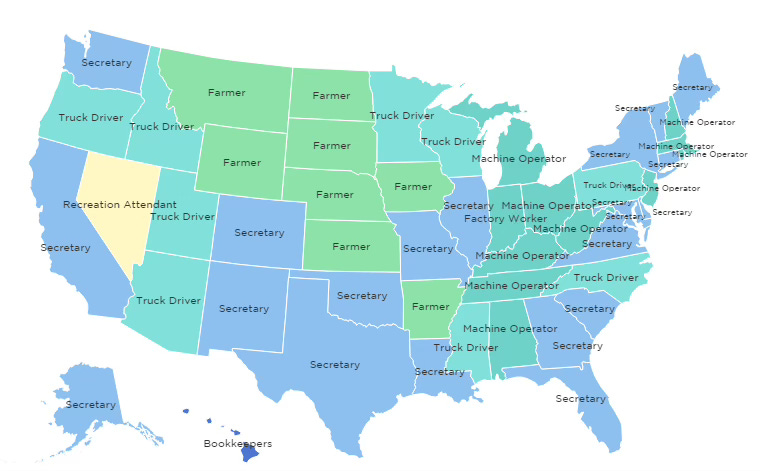
With the exception of truck drivers – for now – every job on that map has been reshaped by automation. (Globalisation played a role too, but it’s far from the whole story.) There aren’t as many machine operators around any more. Nor farmers. And there definitely aren’t as many secretaries.
Their fate is the subject of this essay, and a lens to think through the implications of AI for work with a bit more nuance than “LLMs are a scam” or “white collar work is doomed.” Perhaps those all-or-nothing predictions will turn out to be right! But honestly I doubt it. Instead I think it will be messy, confusing, exciting, strange, unfair and apparently irrational, just like it was last time.
The human interface
Not so long ago, the work of secretaries – typing, filing, organising, administrating – was a cornerstone of the economy. By 1984, six years after the map above, there were around 18 million clerical and secretarial workers in the United States, roughly 18 percent of the entire workforce. This was totally normal. In the UK at the same time, between 17 and 18 percent of the workforce was some kind of secretary. In France it was 16 percent. Different economies with different economic policies; all ended up with one in five or six workers employed in clerical work.
Why so many? Because every stage of information processing required a human hand. In a mid-century organisation, a manager did not “write” a memo. He dictated it. A secretary took it down in shorthand, then retyped it. Then made copies. Then collated the copies by hand. Then distributed them. Then filed them. And so on and so on. Nothing moved unless someone physically moved it. There was no other way.
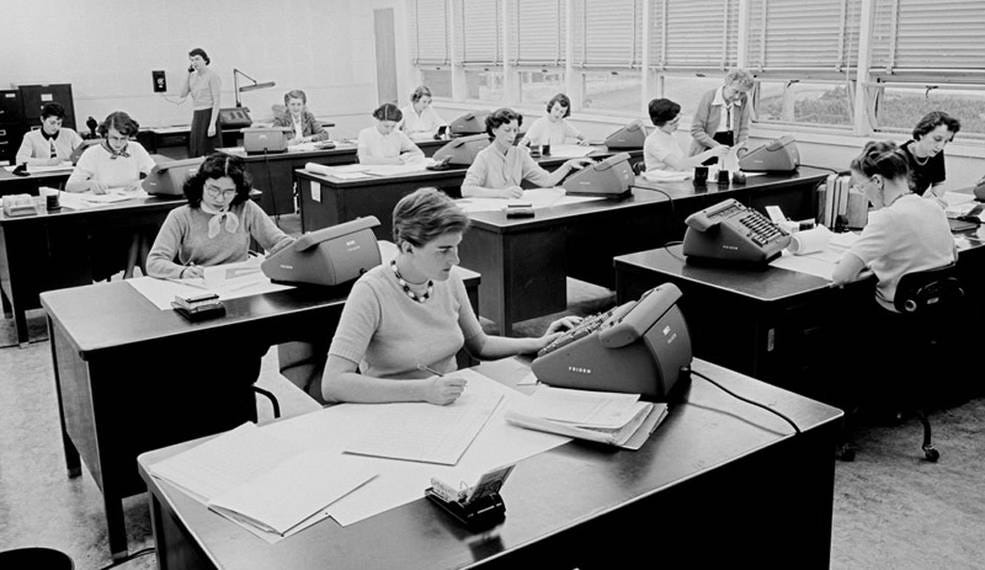
For this reason, the most sophisticated, information-dense organisations were often the ones with the most administrative staff. As NASA prepared to launch the Apollo missions in the mid-1960s, 15% to 18% of its civil service workforce was classified as “clerical and administrative support”. There were the human “computers” made famous by Hidden Figures, but also technical typists, who typed up mathematical equations. As one of those typists, Estella Gillette, later put it: “The engineers depended on us for everything that wasn’t their job. We were their support system.”
This line is often taken as an inspiring motivational quote, but it was a literal description of the situation at the time, because of what today we might call an interface problem. The invention of shorthand and the typewriter in the early twentieth century had made it possible to create accurate records, but senior staff – even engineers at NASA – didn’t interact directly with the administrative machinery of the office. Secretaries and clerks were the unavoidable interface between the manager and the ability to get things done. You spoke to a secretary; they “interfaced” with the shorthand pad and the typewriter. You handed over a paper; they “interfaced” with the filing cabinet. Every kind of activity was organised this way. The secretary was the interface for the diary, a physical object kept only on their desk. (This could be a source of real influence.) They were the human “firewall” or routing system for phone calls. If the manager wanted a coffee, well that was the secretary too. It all went through her.
Then came the personal computer.
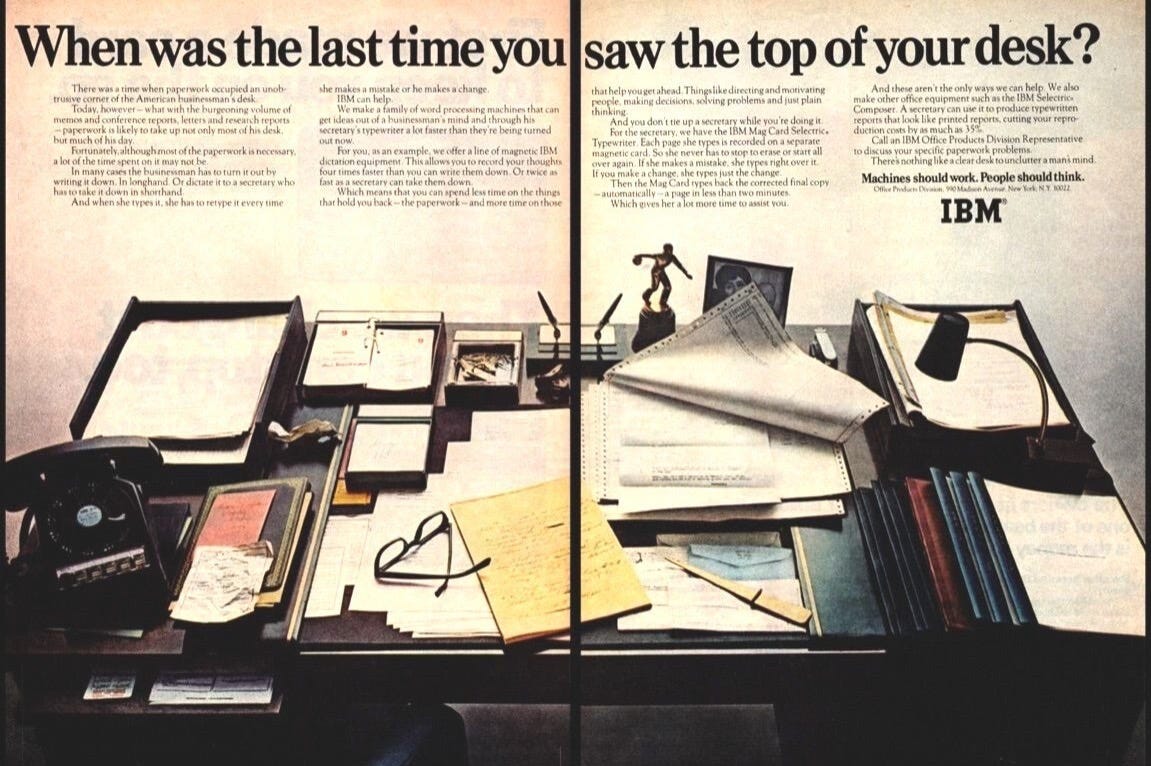
At first the shift to PCs must have seemed almost laughably crude, as physical filing cabinets were duplicated on primitive un-networked computers. But bit by bit the computer and its offspring the internet automated administrative tasks, until eventually many were obsolete.
To find out what this felt like, I asked someone who worked as a secretary during that era: my mum. When she left school in 1972, her parents advised her to seek steady employment, so she attended secretarial college to learn typing and shorthand. She hated it. Then she became a secretary and she hated that too. It wasn’t just the relentless sexual harassment – ”oh yes, that was the norm” – it was the mind-numbing deference and boredom. “You typed a letter, then you put it in a blotter book for your boss to sign, he signed it, then gave it back to you…. One of the worst things was being called in for dictation by someone with a total inability to string a sentence together… It was life sapping.”
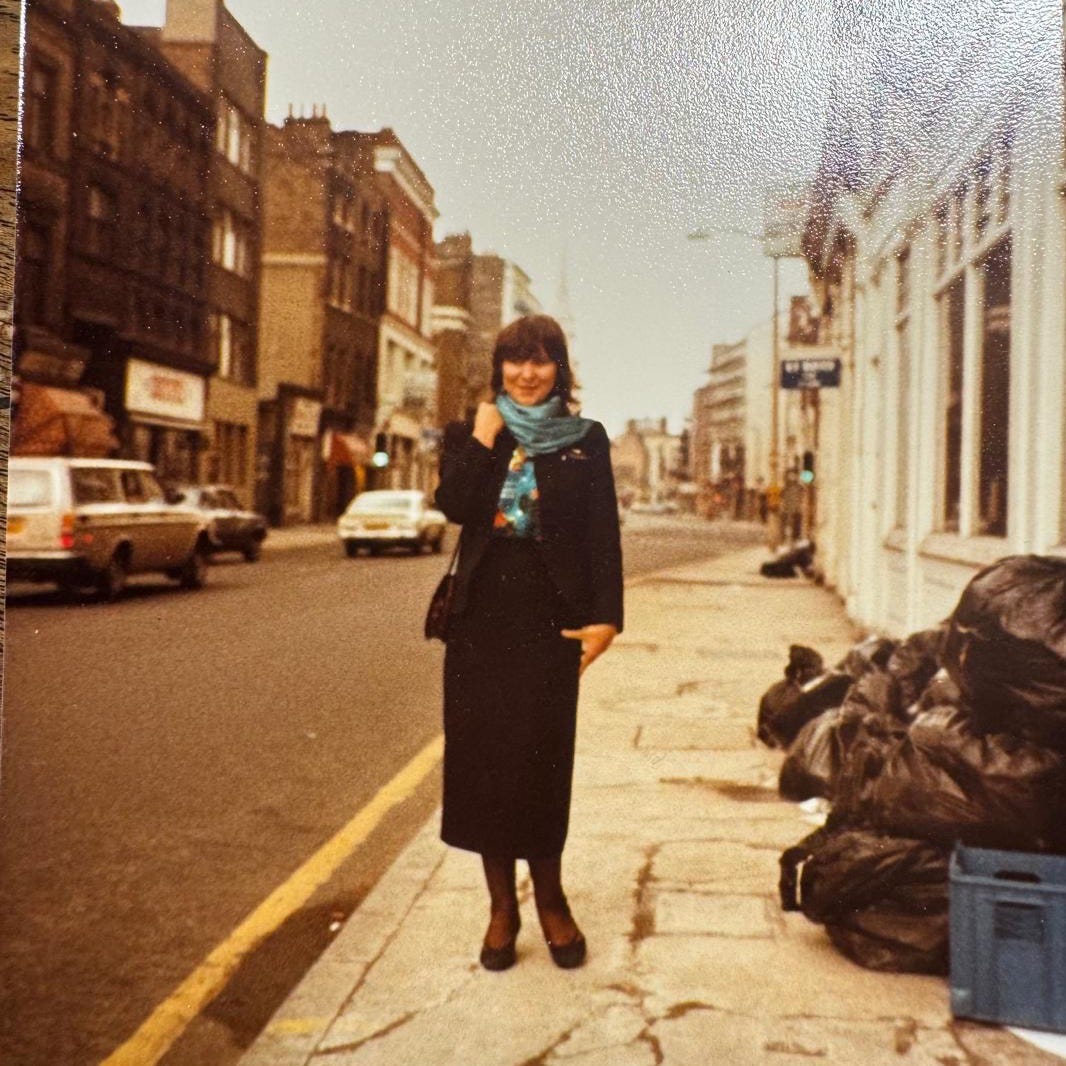
For the first decade of my mum’s working life nothing much changed. Then she went on maternity leave in 1982 and, when she came back to work, everything was different. The bosses had started doing their own typing, “seemingly overnight”. To us this might seem like a small thing, but in this world it was everything. The feudal system of the secretarial age – ”secretary gave status to boss, boss’s status reflected on her, typing pool gave nothing,” my mum recalled – was about to disappear forever.
Now, the interface with the machinery of work is changing once again: from the computer to AI. This isn’t meant as a grandiose statement about the all-encompassing power of AI. I mean, simply, that if you want to get things done, it’s increasingly obvious that the best way is going to be through some kind of conversation with a machine, especially when the machine can then go and complete the task itself. Think of an admin-enabling app, whether it’s Outlook, Teams or Expedia. It’s hard to see a future where they’re not either replaced or mediated by AI.
The computer era unbundled the interface known as “the secretary”. The next era may rebundle it back into AI.
These are the lessons from the last change for the new one.
1. There’s still work
Think we’re the first generation to dream of a workless world? Not at all. “The constant mantra was the wonder of the paperless office and everyone would have more leisure time,” my mum recalled. A 1986 National Academies of Sciences, Engineering, and Medicine paper on new workplace technologies reported widespread claims that “in the foreseeable future, productivity may be so enhanced that employment may become a rarity for everyone.”
Reader, it was not.
2. There are still secretaries
Almost two million non-legal and medical secretaries in the US alone. And not just secretaries - administrators, executive assistants, clerks of different kinds, as well as typists and word processors.
Yes: according to the Bureau of Labor Statistics, there are still around 45,000 people in the United States whose primary occupation is typist or word processor. That’s only 0.025 percent of the workforce, down from 250,000 at the turn of the millennium, but still – they exist. Technological displacement takes a long time to produce literal extinction. An obvious point, but an important one.
3. Although far fewer than people expected
While sellers of machines like word processors hyped up the potential boost to productivity – up to 150 percent increase in secretarial output! – most sensible observers saw little prospect of deep and lasting change for secretaries from computerisation. “The variety of the tasks and the social relations on the job have led to little labor displacement, and little is likely in the future,” concluded the National Academies report, comparing secretaries to nurses in their indispensability.
Tellingly, “secretary” isn’t a standalone category any more in headline UK labour statistics, which makes it difficult to work out exactly how many secretaries of the classic type there are; and in any case the job has changed so much it’s hard to make comparisons at all. But according to the 2021 census for England and Wales, 238,210 people were classified as personal assistants, secretaries or typists, roughly 0.9% of the workforce. In the US the Bureau of Labor found 1,785,430 secretaries and administrative assistants in 2023, around 1.1% of the workforce.
The job my mum did still exists, but perhaps not for much longer.
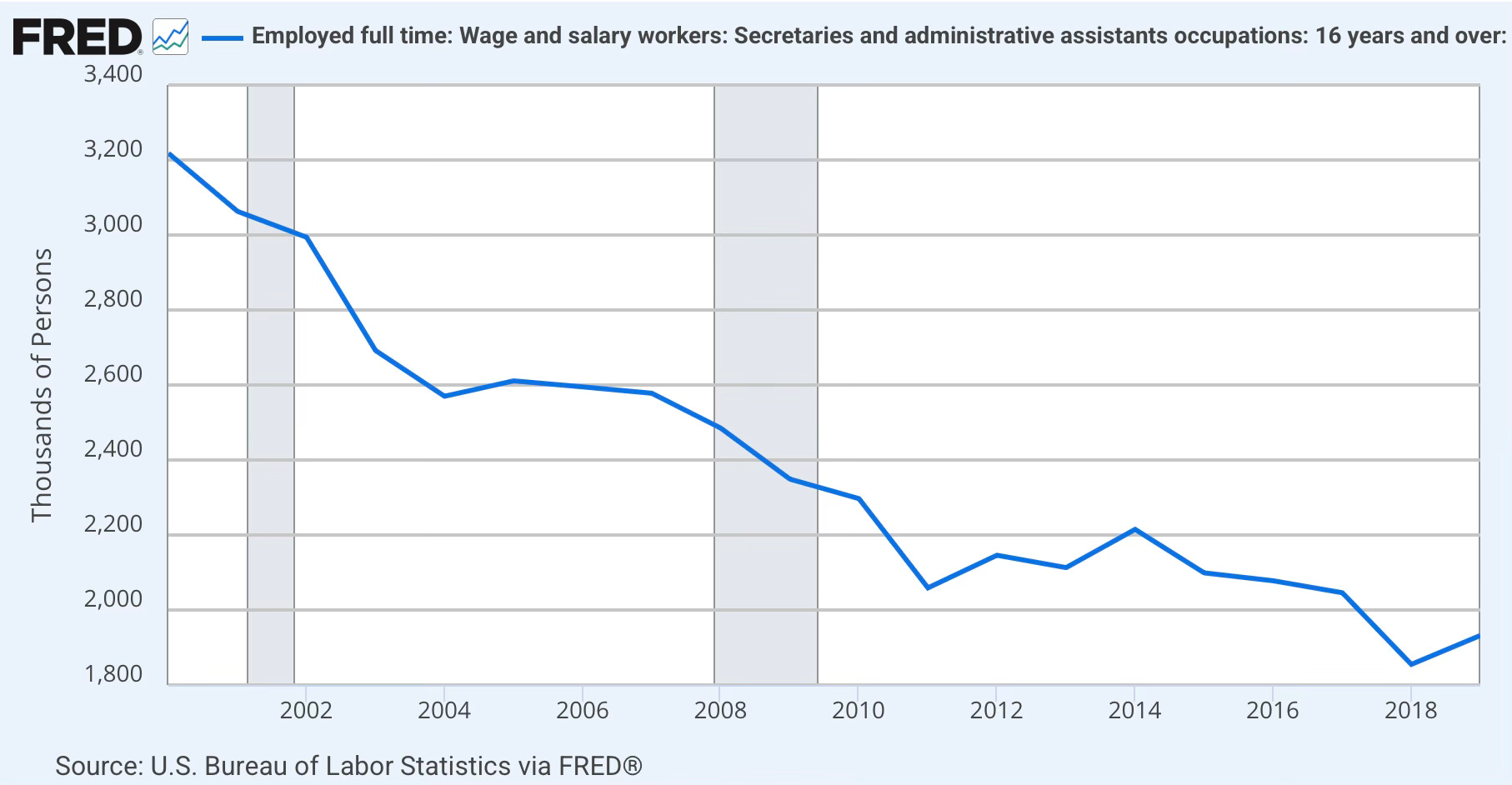
4. That doesn’t mean administrative jobs disappeared
Although officially secretaries are now only around one percent of the employed workers, it wouldn’t be right to say that the administrative share of the workforce has gone from one in five or six to one in a hundred. Not at all! There are still lots of administrators around; they just have different names. Human Resources. Business operations. Compliance. Routine clerical labour became “professionalised administrative coordination.” (Although it was still done mostly by women. Economic change does not always imply social change.)
This is the classic pattern of automation, seen everywhere from farming to the military. You stop doing tasks and start overseeing systems.
Will the same thing happen with AI? If you look at software engineering, it’s clear it already is.
5. And secretarial work didn’t go away either
Most secretarial work wasn’t removed; it was spread around so that everyone did it. If you work in an office today (and even if you don’t), you do your own typing, your own formatting, you send your own emails, you arrange your own meetings and you answer your own phone calls. If you go on a work trip, you probably book your own flights, your own accommodation and when you’re back you file your own receipts.
The scale of this “shadow work” is immense. Imagine travelling back in time to explain that, over a stiff gin and tonic, to a mid-level manager in the 1970s. They would look at you like you’re mad. “You’re telling me this and you say things have got better??” And that’s even before we get to the work created by computers - the endless emails, the meetings which should have been emails, the emails to arrange the meetings which should have been emails, and so on.
So what will be the shadow work of the AI era? An obvious candidate: management. Boris Cherny, who leads Claude Code, doesn’t code anymore. Nor do lots of people at Anthropic. So what do they do? They manage their non-human teams.
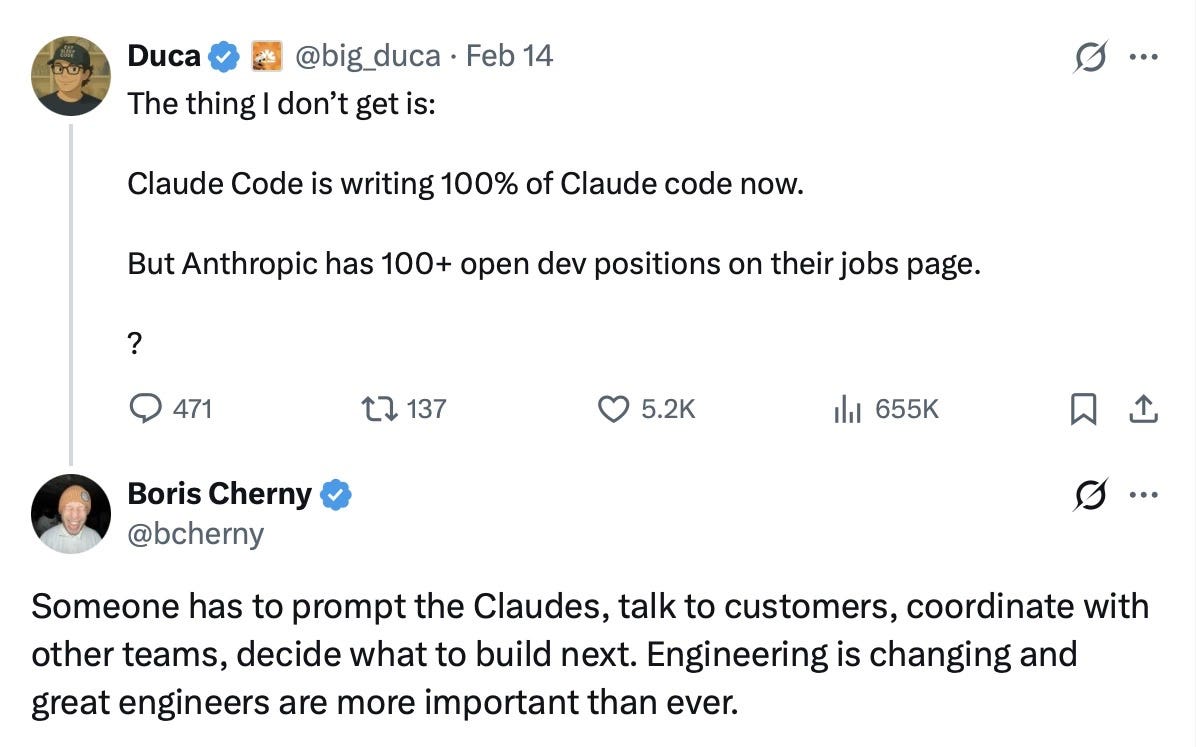
A lot of engineers talk in exalted terms about the feeling of power this gives them. I’ve heard the phrase: “it’s like being the conductor of an orchestra.” I wonder if it will still feel that way when the novelty wears off and the work of supervising and dealing with agents is just another branch of working life. Professor Ethan Mollick calls management an “AI superpower”, but it seems to me that you might also call it an AI chore, something we will have to do even if we don’t want to, that’s by turns draining, frustrating and stressful, and creates as much work as it is supposed to eliminate. As the authors of a recent study put it: “AI Doesn’t Reduce Work—It Intensifies It”.
Computerisation turned everyone into an accidental secretary. AI will turn everyone into an accidental manager.
Regardless, it seems that this is the way things are heading. Computerisation turned everyone into an accidental secretary. AI will turn everyone into an accidental manager.
6. The change was much slower than everyone expected
The personal computer did not immediately reduce administrative employment, it increased it. Some groups of administrative workers – stenographers, for instance – went into terminal decline, but as the economy boomed in the 1990s, the demand for administrative coordination actually went up, a Jevons Paradox for bureaucracy.
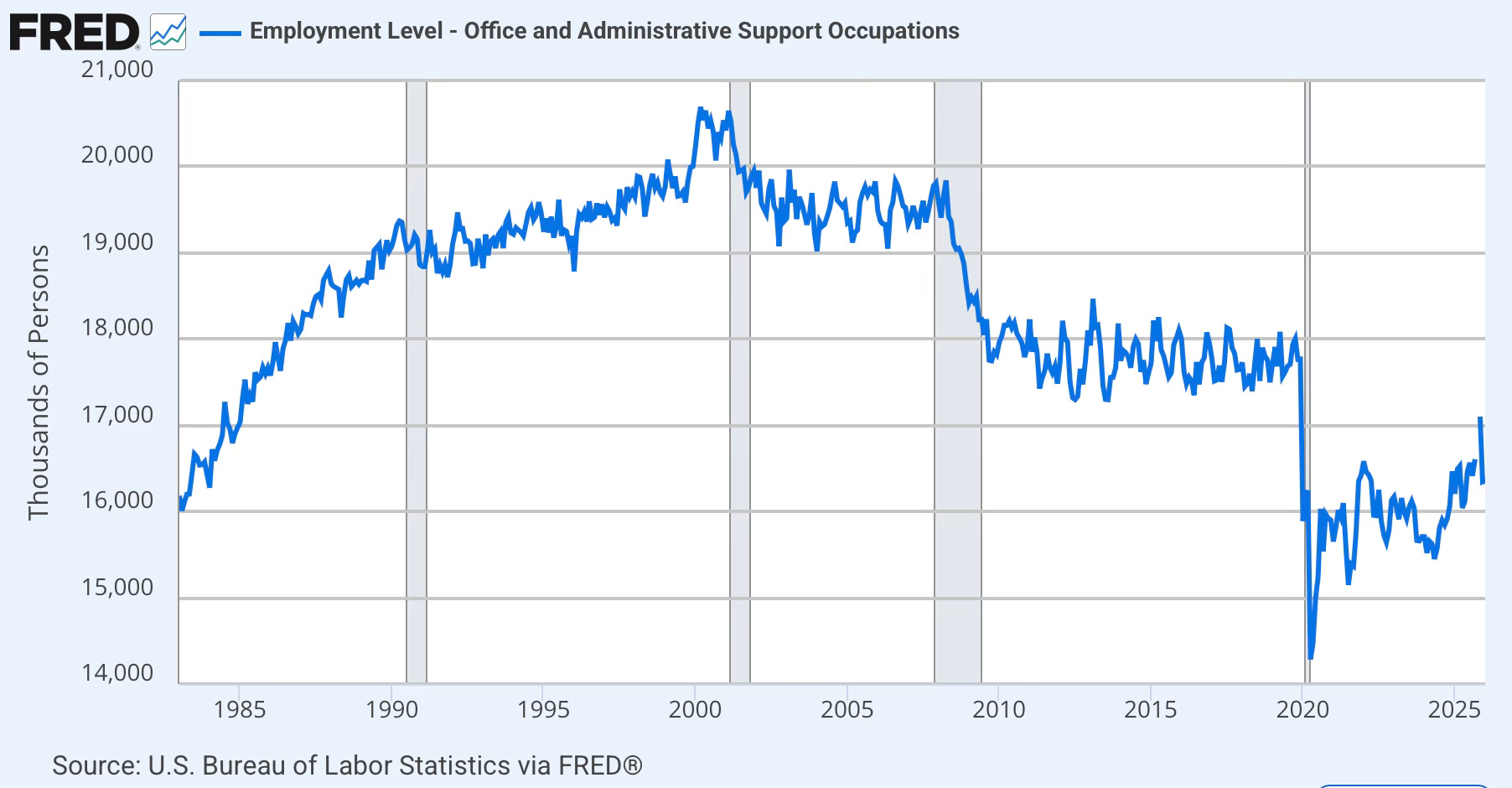
It wouldn’t surprise me if we saw something similar for software with AI; indeed job postings for software engineers are already rising in both the US and UK. Of course even in this optimistic scenario, there will still be a lot of fear and dislocation, just as there was in the 1980s and 1990s. Many secretaries were put out of work and many managers found the loss of their “office wife” painful (“If there is anything a man hates, it is to give up his secretary,” said Evelyn Berezin, the builder of the first computerised word processor). Still, the shock was cushioned because there were opportunities for those that went with the change. It wasn’t until later that computerisation began shrinking the broader administrative workforce, because–
7. Automation happened in stages
Think of the phrase, “on the same page”. Like a lot of sayings – “kick the bucket”; “bite the bullet”; “cut and paste” – it was originally a purely literal description, because making sure everyone had the same page was an essential part of the typewriter era. If NASA updated a manual, someone had to find every copy in the building and swap out “Page 42” with a new “Page 42”, or face potentially disastrous consequences.
For a long time, computerisation changed very little. The first word-processers were really just typewriters with screens: the typist could go back and change the text but everything was still printed in the same way it had always been. At length, computers were able to display digital representations of pages, but although these could in theory have taken many forms, for a long time nothing much changed. Even today there are still plenty of Word documents attached to emails and pdfs with names like, “version 4 final FINAL do not touch”. (Many government press releases take that form.) There are pages and it takes effort to keep them current.
Increasingly, however, the phrase “on the same page” is becoming as divorced from its origin as “hang up the phone”. We are shifting away from pages towards chats and threads; even where we do have pages, they are often stored on cloud systems which make the very idea of out-of-sync copies structurally impossible. (Those systems also automatically scan every word in a document and make them searchable, thereby eliminating the entire task of filing and document retrieval.) The work of staying literally on the same page is being gradually made obsolete.
This shift took decades. Yet although generative AI is, by many measures, the fastest technology ever adopted, that doesn’t mean it will skip the awkward in-between stage. Will AI eventually displace all software in some form? Perhaps – but right now Anthropic and OpenAI use Workday for their HR, so I think it’ll survive a while yet. Are those websites that have a chatbot ready to help (or, just as often, hinder) the final form of this interface? Probably not, but if history is any guide we might be stuck with them for some time.
8. When it came, automation freed and tightened
As computerisation kicked in, secretaries found themselves being asked to take on responsibility for work in larger teams. Some welcomed this change. “Younger secretaries tend not to like the subservient role and are far less likely to be prepared to put up with the behaviour of some very difficult senior executives,” the British Institute for Employment Studies found in 1996. Others found it difficult, as a 1994 Guardian article reported:
Secretaries used to be part of the office furniture, seen but rarely heard. . . . A good secretary was an unremarkable one, efficiently obeying orders, and then returning mouse-like to her station behind the typewriter. . . . Now they [secretaries] are becoming a key part of the team . . . With lots of people competing for a secretary’s time, he or she will need to exercise assertiveness and understand the dynamics of organising the workload of a group
Being moved – or pushed – into a coordination role was better than the alternative. During the first wave of computerisation, many secretaries found that the new technology chained them to their screens, turning the office into an “assembly line”. What’s more, the new computers allowed managers to watch secretaries more closely. From a Washington Post article with the headline “Computers Said To Zap Clerical Jobs”:
Office workers nowadays are doing more work with their new machines. But that productivity usually encourages managers to add more assignments in the belief that the machines and the people using them are capable of handling the load. To ensure that the extra work is done, some companies are using computers to monitor the people using the computers.
It might read like it was written yesterday, but this article was from 1986.
9. Standards went up
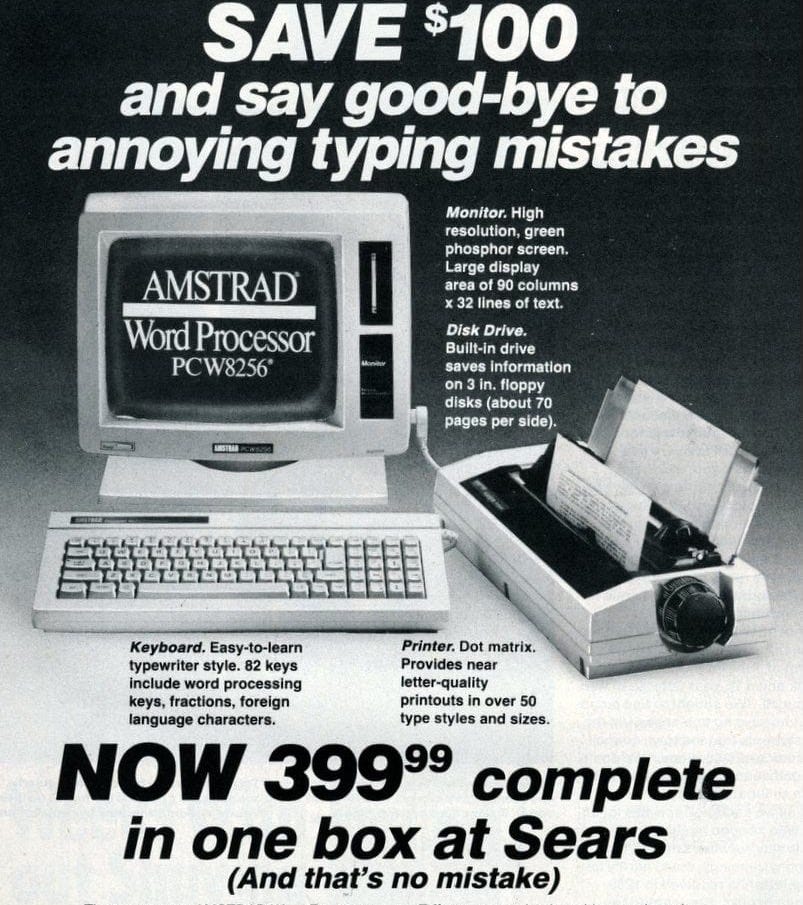
Computerisation brought a shift in standards. “While IT has reduced the amount of typing secretaries do,” the 1996 report observed, “expectations about the quality and accuracy of the work produced have increased considerably.” A universal truth: the more capacity we have, the higher our expectations are.
10. And down
One practice which faded as the typewriter era drew to a close: detailed minute-taking. When every manager had a secretary, it made sense to ask her to record meetings verbatim using shorthand. When they didn’t, this task became seen as an inefficient use of time. “In some ‘action’ meetings a few ‘flagged-up’ bullet points are seen as sufficient record, and these are often taken down by managers,” the Institute for Employment Studies noted in a tone of some surprise.
Funny to think that AI is bringing back the minuted meeting, only this time in the form of transcription. This simple change alone has the potential to spawn a whole industry and a whole new way of working which is invisible to us at present.
11. Some made more money, some didn’t
Here’s a puzzle. As computerisation hit, accounting clerks and inventory clerks in the United States were both equally exposed to automation. Yet between 1980 and 2018, accounting clerks saw rising wages, while inventory clerks saw their wages fall. How can the same effect produce different results?
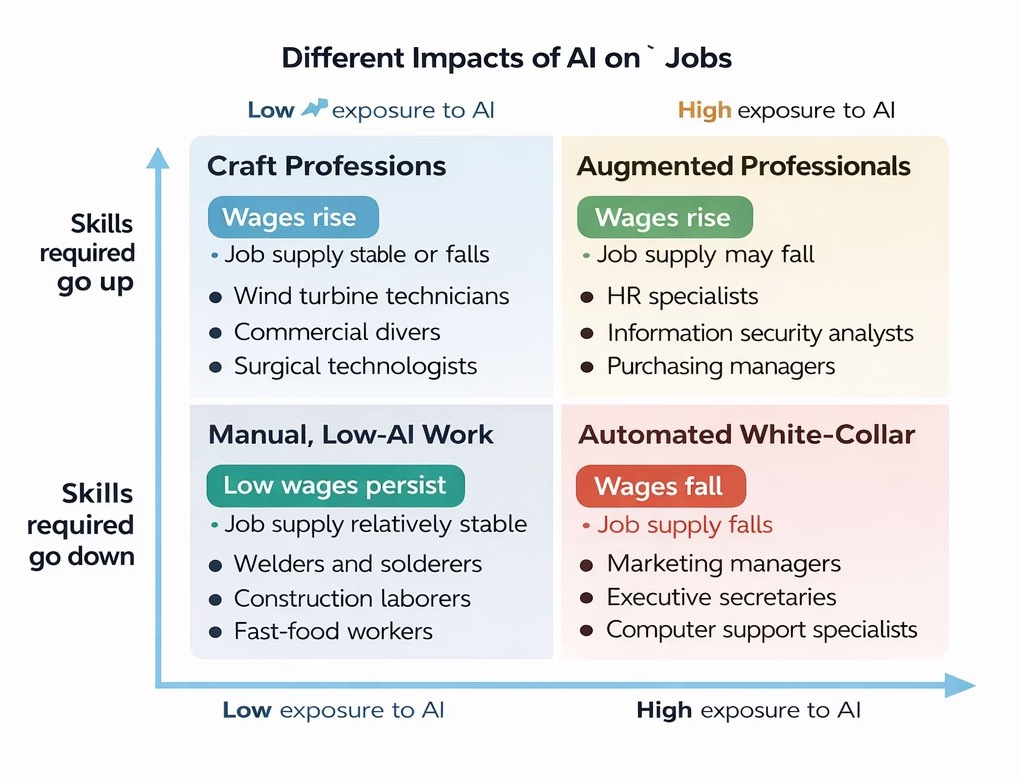
The answer, according to economists David Autor and Neil Thompson, depends on which parts of a job get automated. If the highest-skilled aspects of a job are handed over to a machine, then the threshold for entering it falls, allowing people to come in more easily. The supply of labour rises and wages fall. If the lowest-skilled aspects are automated, then the entry-level jobs are the ones that disappear. The industry becomes harder to enter, the supply of labour falls and wages rise.
This was what happened in the case of the clerks. Inventory clerks saw higher-expertise tasks like working out the price of goods displaced by automation, leaving behind mostly generic physical tasks – that’s why their wages fell. Accounting clerks, by contrast, found that computerisation mostly automated routine tasks like data entry and basic bookkeeping, leaving behind tasks which needed more specialised problem-solving and judgement. Their wages increased while their employment declined.
Early evidence suggests that this same dynamic is playing out again with AI. A recent paper by Bouke Klein Teeselink and Daniel Carey using data on hundreds of millions of job postings from 39 countries found that “occupations where automation raises expertise requirements see higher advertised salaries, whereas those where automation lowers expertise do not.”
Of course you’re wondering which jobs will be hit in which way, and Klein Teeselink and Carey do give some examples. This is ChatGPT’s version of their chart. (I write every word by hand but I need help for the charts.) In short: among those with high AI exposure, they expect wages to rise for human resources specialists and fall for – yes – executive secretaries. The wheel turns once again
12. The change was bigger and smaller than we remember
So, in summary: computerisation ended some jobs, changed lots of others and created many ones. Yet that description covers so little of what really happened, because the biggest change wasn’t to the jobs, it was to the people and how they behaved. This is what I really learned writing this piece. I went in expecting to find out about tasks and technologies and I came out having learnt about a strange world very different from my own, a world now almost entirely vanished.
Accounts from that time, including my mum’s, emphasise that side of things much more than the dry economic account. One oral history from a secretary called Cynthia who worked from 1958 to 2005 mentions how, once, people used to knock at the door of the office – of course the manager had a separate office – and wait to be called. Then, suddenly, they started walking in because they wanted to speak to him directly. That is the world that computerisation helped to bring to an end, and now it is almost impossible to imagine it existed.
The last word has to go to my mum. What happened to her after the bosses started typing? By chance, she was working for a company which leased computers to businesses. She moved into sales and, as computerisation boomed, she escaped the world of the secretary, to her great and lasting relief. She ended up being successful in several other occupations – but that is another story.
So, so many comments rising to mind.
First, congratulations on a strong article. This captures a lot of what has happened to the secretary pretty accurately. It understates how much her social management tasks have been split off to administrative and personal assistants, who believe me are still dogsbodies in the fine old tradition of "honey get me a cup of coffee" and "don't tell the boss I don't have his report ready." It underrates the role of the word processing center operators, who convert, yes, Word files pre-typed by engineers, accountants, consultants, and executives into a) English b) company format standard c) non-gibberish in a larger sense. But there's a lot of good here.
What's missing?
A recent online article reported on the work of a Marie-Kondo-like efficiency expert who is studying the effect of AI on companies trying to adopt it. She found that in many cases AI was "an HR checkbox to be ticked off" - you attend the seminar, just as you attend a safety or non-harassment seminar, and you go back to work. In others, the AI as purchased is good for stuff, just not our stuff. These are the consequences of executives choosing to buy into AI while having no idea what their companies do and indeed no intention of ever using it themselves.
Her most telling finding, and one that I think is overlooked in this article, is that for any company that has been around long enough to develop employee turnover, how things should be done and how they are done are widely separated.
Dave is the Sr VP on that, and his assistant Madge used to handle that, but when she got overworked Madge admitted she wasn't very good at that so she handed that over to Susan, who traded that task for something she sucked at. Susan left, so that was handed off to Susan's successor Jack, who wasn't good at that but still had to do that, because Madge's boss outranked his. Or Madge left and his successor Bob didn't even know he was supposed to handle that, let alone who in this labyrinth has been doing that all along, so Jack (in his copious free time) teaches the new guy how to prepare the necessary bits of that to hand back to Jack to be handled. Then it turns out Bob and Jack don't like each other, or, tellingly, their bosses don't like each other, and since neither of their bosses does much with his day besides curry his own boss and diligently block communication to his boss's rival's area, Bob is forbidden to ask Jack for help, and Jack is only too willing to let him drown.
AI crashes in, creating rational org charts of tasks and their obvious workflows, which resemble the current company operations not at all. Do we stop everything while AI moves us around like chess pieces? These pesky human relationships do not go away because efficiency.
Second. As someone who used to take minutes and who experienced the transition to chats with verbatim capture, I can tell you that much is said in meetings that ought never, ever to be committed to permanent record. These records are admissible in court, as are texts and every other imaginable form of communication captured forever by electronics, and businesses are learning this to their cost. By giving up their human stenographer, businesses gave up that cushion against liability. At least you could threaten or bribe a stenographer.
Third, you state, "(Although it was still done mostly by women. Economic change does not always imply social change.)" Gender in the workplace is not a social factor, it is an economic factor, as is race, and for exactly the same reasons. See Isabel Wilkerson's CASTE.
Fourth. Managers who monitor their underlings' productivity are redundant and they know it. Like a lot of white collar workers, they owe their employment to a combination of nepotism and a superficial inoffensiveness in the office environment. If they had to catch their own food, they'd starve. Their bosses soon figure out they can be spared.
Fifth. Computerization has not improved standards; it has merely homogenized them. When humans do work, even soul-killing work, they either get bored and get out or they start to slack or sabotage or, in the overwhelming majority of cases, they start to pay attention and make it matter, they get fussy, they figure out how to do it better. When computerization was introduced in the offices in the 80s (I was there) there was more hue and cry among the clerks and secretaries that they were being asked to do a worse job only faster, than among those who objected to learning the computer, and this applied not just to document production / handling and records management but to communication protocols. When companies ordered their clerical workers to fit their duodecahedronal tasks into square computerized holes, data was lost forever, as well as these workers' hard-won, thoughtfully developed methods of tracking and processing data.
Sixth. The office wife was a loss that male workers realized immediately. The loss they didn't feel ... immediately ... was the office mom. Call her Sylvia, a woman I met in the mid-eighties when I walked into a temp gig in a mid-size company. (My friend, you cannot hide company secrets from temps. In a week I knew who was having sex with whom, and in ten days I knew which vendors were getting paid 60-90-never, which VPs were scheduled for the chop, and whether the company would be sold or just closed.) Sylvia taught the new secretaries company standards for their work and the corporate culture. What's more, she taught them to put up with the culture. Where the office mom begrudged or shirked that aspect of her job, you had more sexual harassment cases. In brief, Sylvia taught the girls how to be office wives. I was ordered by the low-level HR manager to "teach Sylvia the computer in three weeks or else she's fired." I told him baldly that it wasn't my job to fire his people, but I would teach her the computer. I also related this full conversation to Sylvia. Next time he came boiling out of his office in a panic, demanding coffee, a cab, and that she block all calls from his boss, she looked up and said, "I'm sorry, sir, I'm using The Computer."
THAT was the revolution. Corporate offices have never recovered from this destabilization.
I could rant further but really, this reply is overlong.
What a delightful deep dive and reminder that while this change is happening so quickly, it is not wholly unprecedented. We are all managers now, and love the prediction of what that means for the future of work.