
Notes on Anthropic
A company with Beliefs

I’m always amazed by how different tech companies are. Even brief encounters with different companies feels like visiting a foreign country – you sense the change in tone and style just as surely as you sense it when you arrive in Poland or Italy.
What creates these atmospheres? Mostly, it’s the little things. At Palantir’s London office the downstairs windows are tinted, so they can see out but you can’t see in. People from Microsoft tend to be dressed two or three degrees smarter than everyone else. You get the overwhelming sense from TikTok that they just want to be left alone.
Even by these standards, Anthropic has an unusually strong corporate culture. There is an – to use a horrible term – a definite Anthropicness.
We’re about to get a strong taste of it, because Anthropic is changing its stance towards the world. Up until now it saw itself as a company building and finding a market for AI; now it is ready for the next phase. The way they put it internally is that they are ready to become “a societal actor.”
Whatever Anthropicness is, people feel it, even at some remove. I’m always being asked by people whether they should try Claude. “I hear it’s amazing,” they’ll say. Or: “Aren’t they the ethical AI company?” A friend texted me the other day saying he had just used Claude for the first time and it was clearly much better. This is the equivalent of putting on a pair of Nike trainers and saying you feel much faster.
But Anthropicness isn’t just marketing. There is some cultural essence here too, which shapes which Anthropic does and how it sees itself.
Over the last few months I’ve spent many hours in Anthropic’s atmosphere: reading their papers, attending their events, talking to members of the technical staff. Just this week I interviewed Boris Cherny, the creator of Claude Code, the tool which took Anthropic from a promising AI startup to a global player with a near-trillion dollar valuation.
Ahead of Anthropic’s shift, here are seven scattered observations on Anthropicness.
1. Anthropic is not “ethical”. It is ideological.
I am often asked whether Anthropic is “the ethical AI company”. (Once, on a podcast: “Is Anthropic woke?”) I never know how to answer, because the question assumes the problems created by AI can be neatly sorted into right and wrong and that it is obvious who is choosing which path. To me, it’s not obvious at all. Was it ethical to accept certain defence work? Was it ethical to later refuse it? Is it ethical to restrict access to chips if the alternative is empowering authoritarian states – or unethical to entrench American technological dominance? I don’t know, but what I do know is that “good and bad” doesn’t cover it.
More broadly, I think the label is misleading, because when people say “ethical” they usually mean a vague set of “good” values. To me what is important and unusual about Anthropic is not that it has values but that it has beliefs. Actual beliefs – about risk, the state, geopolitics, labour markets, scientific progress, information control and so on.
Earlier this month, for instance, Anthropic published a paper arguing in very forceful terms that China should be prevented from competing with the United States in AI. Amazingly, it did so, during President Trump’s visit to China. Normal companies don’t do this! Is this ethical? I have no idea. But it is definitely ideological. Anthropic behaves according to a strong set of beliefs about how the world works and what must be done.
2. Anthropic still feels like a startup
At a private event in Westminster for policymakers, one of the guests sidled up to me over coffee and said, “Do you know why we’re here?” Someone else joined in: “No! Do you?” Compared to the ultra-slick lobbying efforts of companies like Waymo, Anthropic can feel a little haphazard.
It might not seem like it, but this is really a compliment. Slickness is overrated; what Anthropic has is a sense of racing ahead and driving towards the same mission. No doubt this will change as it gets bigger, but right now it still feels like a place you go to get things done. As anyone who’s worked at Meta recently will tell you, this is not something you can take for granted.
3. They’re not scared of journalists
Normally when you arrive at a tech company event as a journalist, you are given a brightly-coloured lanyard warning people that you are not to be trusted. Then you are carefully herded around to make sure you don’t have any illicit or unauthorised contact.
Another common practice is to try to make you sign an NDA, even though they must know that they shouldn’t. This happened once when I was going into Meta. When I refused, they brought out a second, even more glaring lanyard to signify that I was especially dangerous. And then all the conversations were off the record anyway.
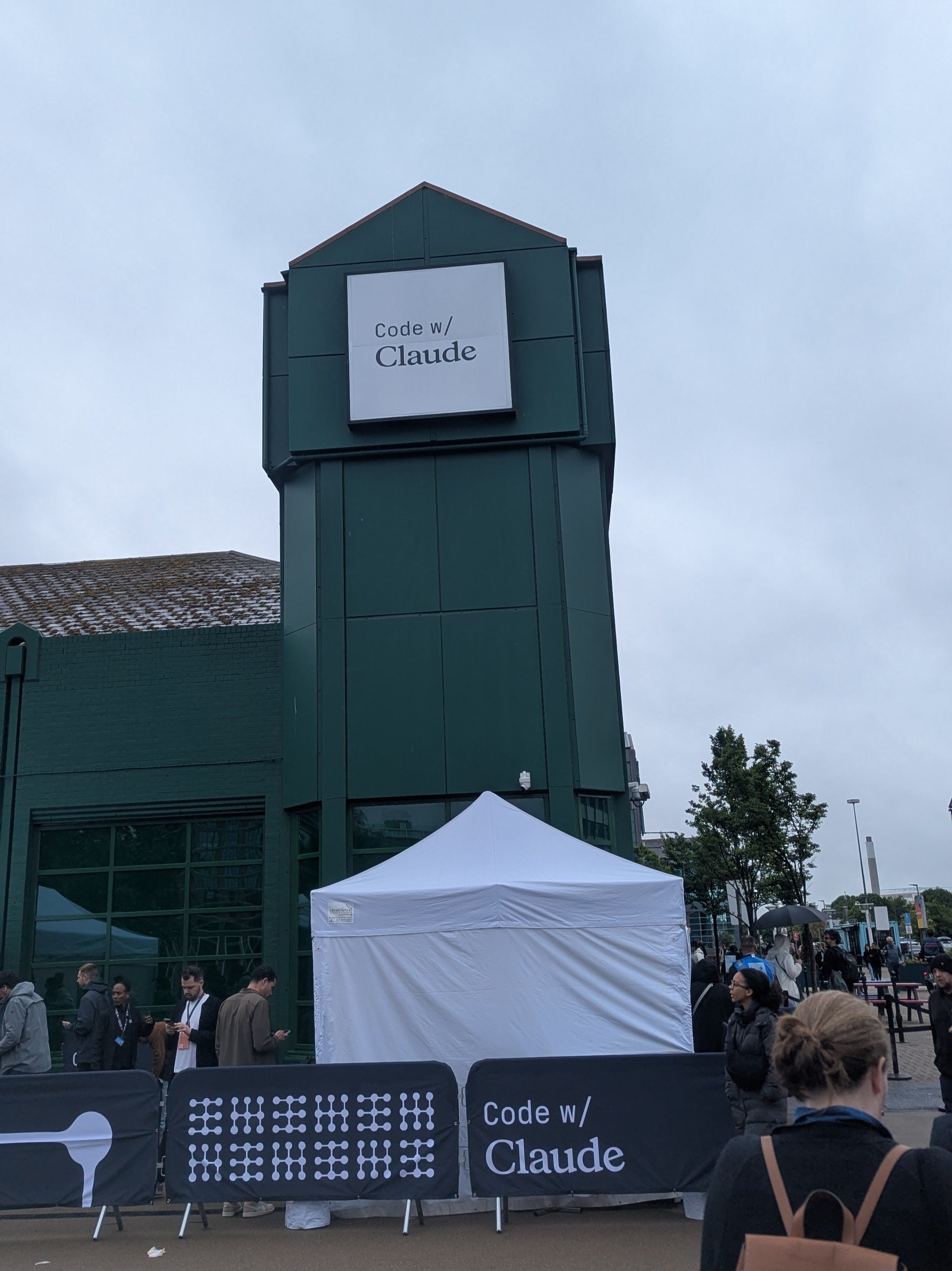
Okay, maybe Anthropic is a little scared. It’s not totally open, of course. This is still a company in an incredibly competitive and sensitive industry, with plenty of reasons to mistrust the media. But the default setting feels different. At Code With Claude journalists were allowed to wander around at will and speak to researchers. At the private Whitehall event we were treated like members of the audience (although we did get special badges). I’ve spoken to more technical members of staff at Anthropic in the last few months than I have in years through official channels at Google. Maybe that’s just because Google has people for that and Anthropic doesn’t. But still – it feels different.
Just before I interviewed Boris Cherny, he said: “I always tell the press people not to tell me the questions. I want to be able to react on the spot.”
For someone who isn’t a CEO, that’s rare, although of course it helps that…
4. The doom is sincere
Anthropic doesn’t mind what most companies would see as bad press; in fact, often bad press is the point. You see this in almost any interview. At some point they will utter dire warnings about jobs or safety or cybersecurity.
Sometimes people describe this as a marketing tactic. If it is, it is not one that has been invented by the company’s marketing team. It comes directly from the top and is repeated all around the organisation.
A few months ago I interviewed Anthropic researcher Miles McCain about derangement caused by AI misleading people. After the interview ended, we carried on talking and he mentioned that one of his former professors believed AI would dramatically improve the quality of advice across the board. “Oh,” I said, “you should have said that.”
He replied, “That’s not the Anthropic way.”
Most companies are terrified of sounding too negative. Anthropic people sometimes seem afraid of sounding too positive.
5. Anthropic behaves as if places outside San Francisco exist
Code with Claude is basically the Anthropic equivalent of Google I/O: an annual developer conference, with keynotes, demos, workshops, product announcements etc. By coincidence Google I/O was last week and of course it was in California. There was no doubt it would be anywhere else. Apple Events are in California too. So is Meta Connect.
I mention this to explain how unusual it is to have a major developer event in London – and while the London event was going on, Anthropic co-founder Jack Clark gave a lecture in Oxford. Normally the leaders of major tech companies descend on the UK, make a few canned announcements and give an interview to the BBC. Clark – who is British and a former journalist – was recently interviewed at length on Channel 4.
Code with Claude was going onto Tokyo afterwards. I have no idea what this means or if it will continue, but it’s certainly very different.
6. This is just the beginning
Up until now, Anthropic has been the plucky underdog. If things carry on the way they are, they will be the industry leader. When that happens, things have the potential to change very rapidly.
Take the “ethical” tag. There were mutterings in tech about the way Anthropic issued copyright takedown requests to remove copies of Claude Code source code, but it didn’t make it into the mainstream. Neither did the environmental costs of the decision to use SpaceX compute or the decision to publish that piece about China during President Trump’s visit.
Companies make these compromises all the time, but once you’re the industry leader, each decision can be enormously magnified, especially if you’re perceived to have previously claimed the moral high ground. Just ask Google – that “don’t be evil” thing still sticks, even to this day.
7. The King and the Believer
If I had to guess why Anthropic is unusual, I’d say it all comes down to that core set of beliefs. Everything flows from there – the startup mentality, the confidence to talk to media, the ability to say “bad” things without fear of retribution.
As I’ve written before, one of the things I love about technology is that it is philosophy where you get to find out the answers. That’s why I am so fascinated by the clash between Anthropic and OpenAI.
On one hand, you have Sam Altman, the ultimate deal-maker. Someone who, as Paul Graham once wrote: “You could parachute him into an island full of cannibals and come back in 5 years and he’d be the king.”
On the other side, you have Dario Amodei, who has beliefs so strong he’ll walk away from the Pentagon on a point of principle.
This does not mean OpenAI has no beliefs, or Anthropic has no pragmatism. Obviously both have both; but they seem to place them in a different order. OpenAI gives the impression of a pragmatic organisation with a mission. Anthropic gives the impression of a mission that has had to build a company around itself.
Does history favour pragmatism or ideology? Deal-making or doctrine? I will, of course, report back.
Good post. My sense is that in thinking about its ideology, Effective Altruism is and has been more central than many realise and than even Anthropic is willing to publicly acknowledge. EA is both a set of beliefs and values, but it's also an entire epistemic network involving specific thinkers, core texts, ways of speaking, etc, which are influential not just in shaping how Anthropic the company behaves but also how Claude itself behaves.